
Faces Three (Part III): Trivius Dea
Life At The Wayside
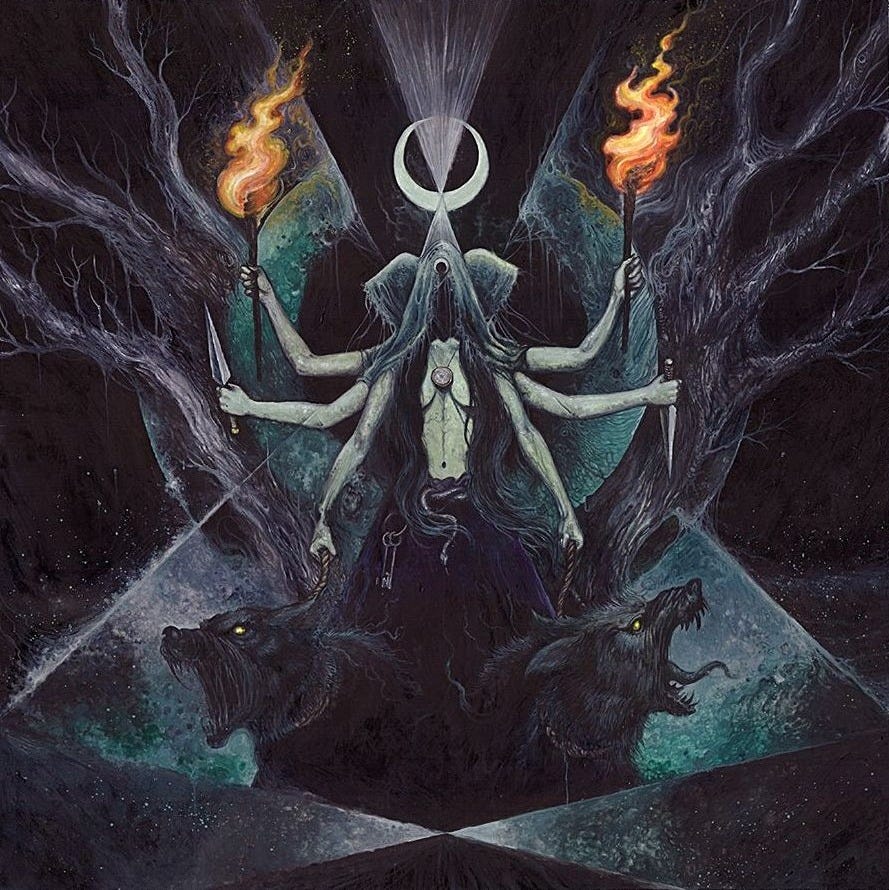
The last part of the series. If you missed the earlier posts, start at the beginning.
Previously, I wrote about Hekate personifying the crossroads. I also hinted at her Trivia overlapping with other contemporaneous mysteries. More would come of that.
I wrote much of this article based on my own meditations and speculations on what little I know of Hekate and her mysteries. I would later uncover confirmations of it in the midst of research. In fact, much of this series was already written well before I stumbled onto the Chaldean Oracles and other branches of research, which forced a lot of revision and addition.
I say this not as a boast, but to share the synchronistic confirmation of what appears to be a spirit-led revelatory process, as well as illustrate the claims that the Chaldean Oracles themselves may have been channeled works. Works in which it is difficult to distinguish source material from divine inspiration. I believe I may have been given minor access to that same source or stream of consciousness. Thank you Hekate, lovely goddess of divine revelation.
The Wayside
Liminal states such as trance and hypnagogia live at the impossible membrane between the conscious and unconscious. The two join to create something that is more than will or faith: a path. The interplay of Macrocosm and Microcosm, with creation itself relying on the synthesis between the two. A convergent Trivium.1
Another thing that comes to mind is the significant difference between a four-way crossroads and a three-way. Perhaps with Hekataean eyes, the in-road is missing from the configuration? From a practice perspective, this de-centers point of origin. Removing the in-road positions you as the only point of origin worth recognizing. This indicates the extraction of one’s agency from one’s past, and linear continuity. A divergent Trivium.
Again, these are themes one might expect from a goddess of indeterminable origin, who defies measurement and personifies the sheer potentiality of the unknowable. By her very nature, Hekate challenges the modern fixation on linearity, causation and fact.
This acausality also swims with the phenomenon of Immaculate Conception, but breaks with a literalized interpretation of it. This gives the ‘virgin birth’ back to metaphor in a way that seems more true to life - because it is more true to the weird and acausal.
The more I sit with my impressions of Hekate, the more I’m reminded of the Blessed Virgin Mary. Bet you didn’t think I’d try that one, did you? But just as Rosary is a clandestine survival of goddess worship in the Catholic tradition, Hekate appears to be one survival in a Magna Mater lineage going all the way back into pre-history. Mama finds a way. A more tenacious love there never was.
I could speculate all day, but I do find it noteworthy that we have Mary and Hekate both at the center of their own triadic mysteries arising around the 2nd Century C.E. Prayers and devotions to the BVM are also known to have been in full swing between the 2nd - 4th Centuries. By the way, how many magi were at that manger again?
It could be that trinitarian thought arose phenomenologically, and became entangled with several figures and traditions in the syncretism of the Hellenic period. If that is the case, then how was the concept of trinity experienced at that time, and why was it so infectious?
Maybe it was all just code for ecstatic sexual union. Nothing moves like a sexy secret, and it is well known that Hekate’s earliest known celebrations were in tight regional proximity to the orgiastic cults of Cybele. Plus, I mean just look at the uterus: To this very day, it may be the most beautiful and mysterious triangle to build a religion around.
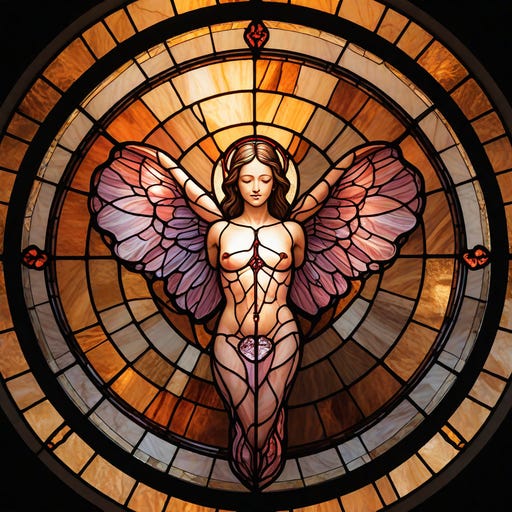
Understand that I’m not attempting to mash any figures or traditions together irresponsibly or irreverently. I just feel obligated to acknowledge archetypal bleed-over.
Speaking of which, let’s discuss archetypal bleed-over. I apologize in advance.
A Syncretic Nutshell
I won’t go into detail about the phenomenon of Hellenic Syncretism itself. Suffice to say they remixed a lot of originals.
As previously mentioned, her earliest origins we can suppose are as an Anatolian goddess, contemporary of the fertility goddess Cybele. There’s no evidence that she and Cybele were conflated, but Cybele’s presence goes all the way back to the neolithic. There’s no way of knowing the origins of either one.
After her import to Greek mythology via Artemis, Hekate was said to have helped Demeter2 find Persephone in the underworld after her abduction by Hades, and would later accompany Persephone in her yearly journeys to and from his realms. This provides her a crucial role in the Eleusinian Mysteries and brings her into overlap with pre-Christian Gnostic traditions.
The descent and journey of redemption through the underworld does resonate with Sophia of Gnostic cosmology, but also hearkens back to the more ancient story of Inanna and Ereshkigal from earlier Mesopotamian myth, with Hekate often being mapped to Ereshkigal, and Persephone to Inanna. Although these stories are not identical - and roles certainly blur between them - they appear to be dipped from the same mythic stream.
Sound confusing? I’ll venture a guess that maybe that’s the way she likes it. If you’re a key-holder, you might as well have plenty of gates. This also might inform some of my previous questions regarding deliberate suppression. At what point do we posit the agency of the mystery within that deliberation?
It would seem that mysteries exercise their own impetus in order to re-mystify themselves and remain…Eleusive? Human folly may even be their primary means of locomotion. Historical pedantry is more of such folly - an insistence on material accuracy and hard proof misses half the story (at least). Then you war over it. To the Mystery, all of this is grist for the mill. The more we feud, the more we lose, and the more veils she pulls over herself, laughing all the while.
Things can’t sneak up on us if we don’t forget them, and that’s no fun! The gods want to reinvent themselves and tell their stories anew. Every burnt book is just compost for new life to take root at the Wayside. Think about how excited they might get for a mass extinction event…
Trivius Dea
Hekate is centered in the Chaldean Oracles as the intermediary between the upper realms and the lower physical world. As the alchemizing of a Father intelligence and a Mother wisdom, she is seen as being responsible for the Anima Mundi.
That’s a really big deal. Being the originator of the World-Soul would essentially make Hekate the patron deity of what we recognize as Animism, or any other ontology that posits a living universe. In this model, her emanations hold sway over what occurs in the sub-lunar sphere. It was around this time that Hekate became associated with the moon specifically.
With three being the most basic requirement for physical shape from a geometric as well as prenatal perspective, we are pointed once again to the primacy of the womb as a human expression of Threeness. There is also something here that strikes me regarding triangulation being required for locating and targeting. By resonance with these principles, Hekate is placed at the threshold of the entire world of forms.
Overarchingly, from system to system, she appears to be the glue that holds it all together and connects the various dimensions and layers of reality. Hell, one could even liken her to the all-connecting dame.
Considering that the Chaldean Oracles and Orphic Hymns3 are contemporary works of other channeled texts like the Corpus Hermeticum, and that central to their metaphysics is a living and interconnected cosmos, we once again find Hekate’s prominence at a very lively crossroads. This time keeping company with Hermes Trismegistus and the thrice-great mystery of his name, but also the Trivial symbol of the caduceus; standing for the synthesis between rationale and faith, conscious and unconscious, father and mother, something-something kundalini and probably some other stuff too, I betcha!
In the Gnostic conception of the Oracles, Hekate is seen as guiding pupils to Gnosis - the ecstatic wisdom that liberates one from the gross material clutches of the Demiurge. In this way, she is likened to the Sophia of Gnostic scripture; albeit an earth-bound Sophia, interfacing with “lower” forms (dog, serpent, bull…) in order to find purchase in the world of forms. Sophia in a goth dress, bringing you the keys to the proverbial Black Iron Prison.4
The unexamined dualism of Neoplatonic philosophy and its denigration of all matter can be seen as its own kind of prison, but I would argue that Hekate’s power is transcendent of that, which is the point.
Hekate is also referenced in the “Gnostic text” Pistis Sophia, though very unflatteringly. This text is said to have possibly originated in the 3rd or 4th Century C.E. - well after the writing of the Gospel of Thomas and other Gnostic source texts that would comprise the Nag Hammadi Library - placing it more in proximity to events such as the Council of Nicea and the Murder of Hypatia.
This indicates to me that the black-ball of this goddess began during early Christianity’s sweeping attempts to legitimize its doctrines by attempting to cover over its own heretical roots.5 She was not a goddess of the underworld until she was forced underground.
This appears to be part of the hijack of Gnostic philosophy necessary for Christianity to eventually become an appendage of state power. All philosophy must be made compatible with violence if it is to be wielded by empire. Naturally, that means it will be wrenched away from feminine influence as a matter of course.
This co-opt of liberatory theology by authority once again reflects the archetypal story of empire - which mirrors the metaphysical appropriation of Spirit to Matter. A Demiurgic distillate. A cosmic rendering unto caesar.6
Speaking of authorities, I feel the need to circle back around to the Platonic Trivium of grammar, logic and rhetoric. From the wiki:
Grammar teaches the mechanics of language to the student. This is the step where the student "comes to terms," defining the objects and information perceived by the five senses. Hence, the Law of Identity: a tree is a tree, and not a cat.
Logic (also dialectic) is the "mechanics" of thought and of analysis, the process of composing sound arguments and identifying fallacious arguments and statements and so systematically removing contradictions, thereby producing factual knowledge that can be trusted.
Rhetoric is the application of language in order to instruct and to persuade the listener and the reader. It is the knowledge (grammar) now understood (logic) and being transmitted outwards as wisdom (rhetoric).
Aristotle defined rhetoric as, "the power of perceiving in every thing that which is capable of producing persuasion."[5]
Thinking with the command of language as a primary occult power, and thinking with Hekate as the keeper of cosmic keys and way opener, we could infer that some of those keys are related to the linguistic mechanics of the universe. She is known as a teacher of the magical arts, so it stands to reason that she would teach its grammar, logic and rhetoric; structure, division and “persuasion” respectively. Learning the rules in order to break them effectively.
It’s also worth mentioning that language doesn’t always look like what you can see on this page. How does the universe speak? Through recursive mytheme. What is the grammar of that synchronous pastiche? What are the parts of speech in the archetypal collage? Whatever those rules might be, they almost certainly don’t stay static forever. She teaches of an ever-shifting order.
A complex phenomenological language of universal scale knows no boundaries. It demands the use of all sensory capacities. Hekate is a sensory goddess. Torches, dogs and snakes are all for the hunt. The torch corresponds to vision, the dogs to hearing and smell, and the snake to touch and taste. She tells us to make all our senses available to magic. Some things need illuminated, but others need slithered on.
Maybe I’m saying the quiet part out loud, but I hope Our Lady of the Crossroads doesn’t take offense. In fact, this whole thing feels spirit-led. I’m hoping that revelation serves as an acceptable offering. Can revelation be part of venerating the Mystery?
I believe a better question is: Can the Mystery be venerated without revelation? I don’t think so.
Light and Dark hold each others’ forbidden fruit. There is a chase. A divine hide-and-seek along sacred leylines of interpenetration. Anticipatory build-up and release.
Revelation is orgasmic.
The whole of creation is the wayside and everything is tangential. But wherever trails converge, a reminder from the Trivius Dea:
No one can close the road if you know how to step sideways.
General References:
Wikipedia
Written before research. From the wiki page on the Chaldean Oracles:
The Oracles further posit a boundary between the intellectual and the material realms, personified as Hecate. As a barrier or membrane, Hecate separates the purely intellectual fire of the Father from the material fire of the cosmos, and mediates all divine influence upon the lower realm.
It’s also fascinating that Demeter was known as a harvest goddess, while the hekat was the standard Egyptian unit of grain measurement. All this came up on an accidental leg of research. The hekat is derived from an approximation of Pi, and used in a ratio to determine the quality bread and alcohol content of beer. I cannot responsibly get more technical than that seeing as how I’m bad at math and I also hate it.
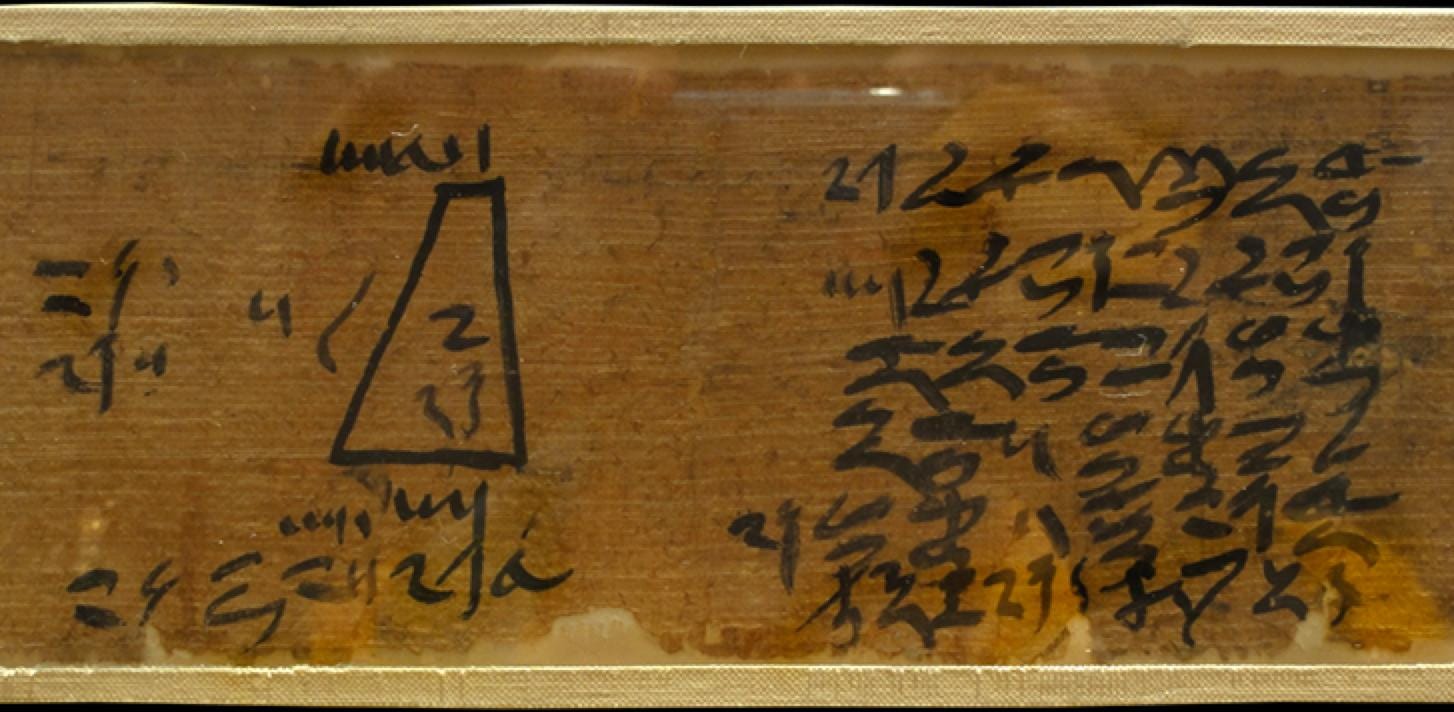
All of this is pulled from Egyptian writings from approx. 1850 B.C.E. Which means that some of the earliest records of mathematical technology are appropriated to the brewing of alcohol, and Hekate is implicated in the most essential units of measurement to be found in them. This could even be the origin of her name among the Greeks.
Talk about holding the Keys. Of course a liminal goddess would be celebrated for her gatekeeping of altered states. This points toward her long-standing link with pharmakeia and plant magic in general. She knows how to get us off our faces, because she has three of them.
Where she is placed the first among all the gods to receive a hymn!
It does need saying that Hekate’s dark, nefarious aesthetic did not come around until later - most likely in the Middle Ages.
Gnosticism is the most dedicated fundamental heresy on human record; a sort of cosmological anarchy. Some have called it ‘The Original Conspiracy Theory’.
This links arms with the Discordian principle stating that the cosmic adversarial force invariably manifests as forms of authority, which I don’t have to tell you, since you’re the Pope of it.